> ## Documentation Index
> Fetch the complete documentation index at: https://control-dev.mintlify.site/llms.txt
> Use this file to discover all available pages before exploring further.
# How Control models data
> Understand entities, local data, group structures, mappings, and statement layouts.
Control preserves source-system data while adding a separate reporting structure. This separation makes consolidated reporting possible without renaming or rebuilding the source systems.
## Core concepts
| Concept | Meaning |
| -------------------- | ---------------------------------------------------------------------------------- |
| Entity | A company or reporting unit connected to one or more source systems. |
| Local account | An account as it exists in an entity's accounting system. |
| Group account | The shared reporting account used across entities. |
| Local dimension item | A source-system value such as a cost center, project, or department. |
| Group dimension item | The standardized reporting value used across entities. |
| Mapping | The link from a local account or dimension item to its group equivalent. |
| Statement layout | The presentation hierarchy for a P\&L, Balance Sheet, Cash Flow, or custom report. |
## Accounts and statements are separate
An account mapping answers: **Which group account should receive this local account's transactions?**
A statement layout answers: **Where should that group account appear in the report?**
Changing a statement layout does not remap source transactions. Changing an account mapping can change report values anywhere that group account is used.
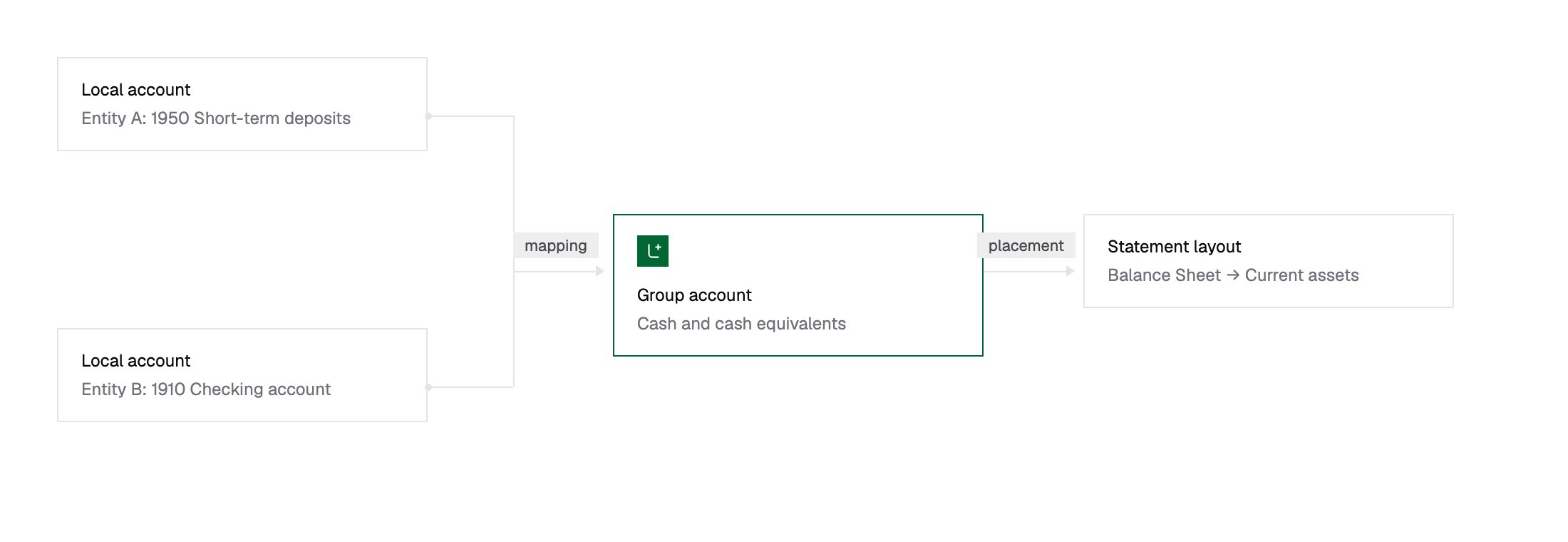
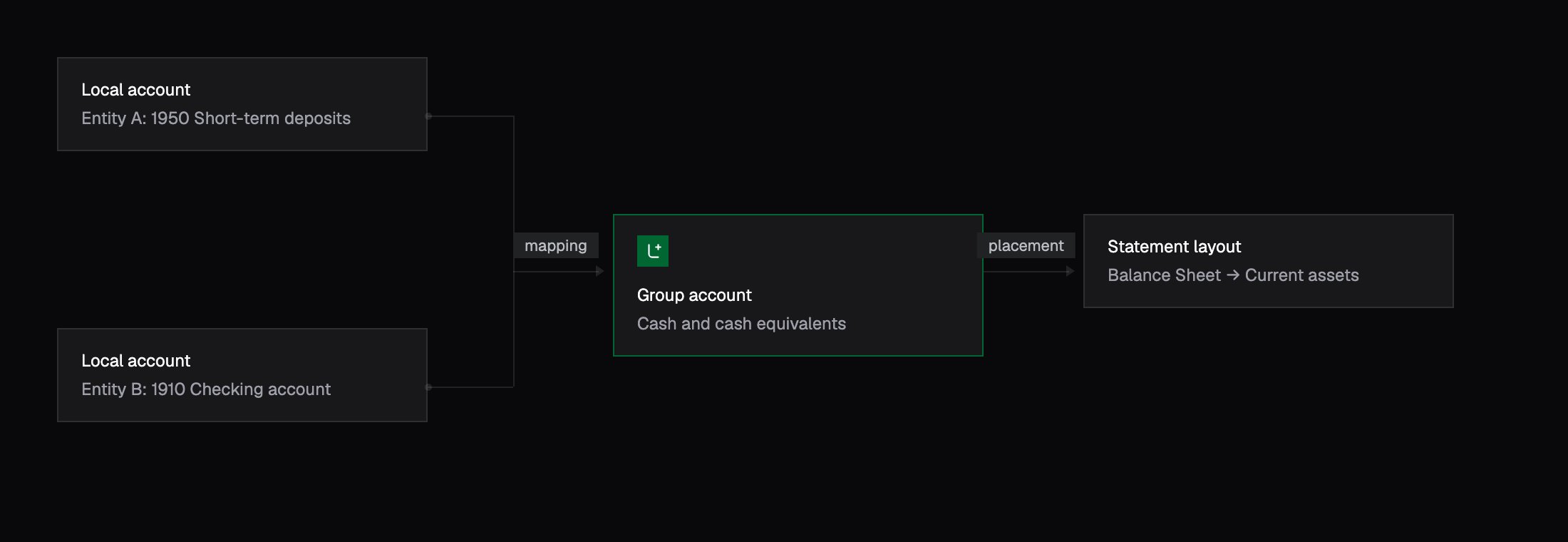 Multiple local accounts, from one or more entities, can map to the same group account. That group account can then appear in one or more statement layouts.
## Dimension hierarchy
The same separation applies to dimensions: local dimension items map to a group dimension item, and group dimension items can have their own parent in the hierarchy.
Multiple local accounts, from one or more entities, can map to the same group account. That group account can then appear in one or more statement layouts.
## Dimension hierarchy
The same separation applies to dimensions: local dimension items map to a group dimension item, and group dimension items can have their own parent in the hierarchy.
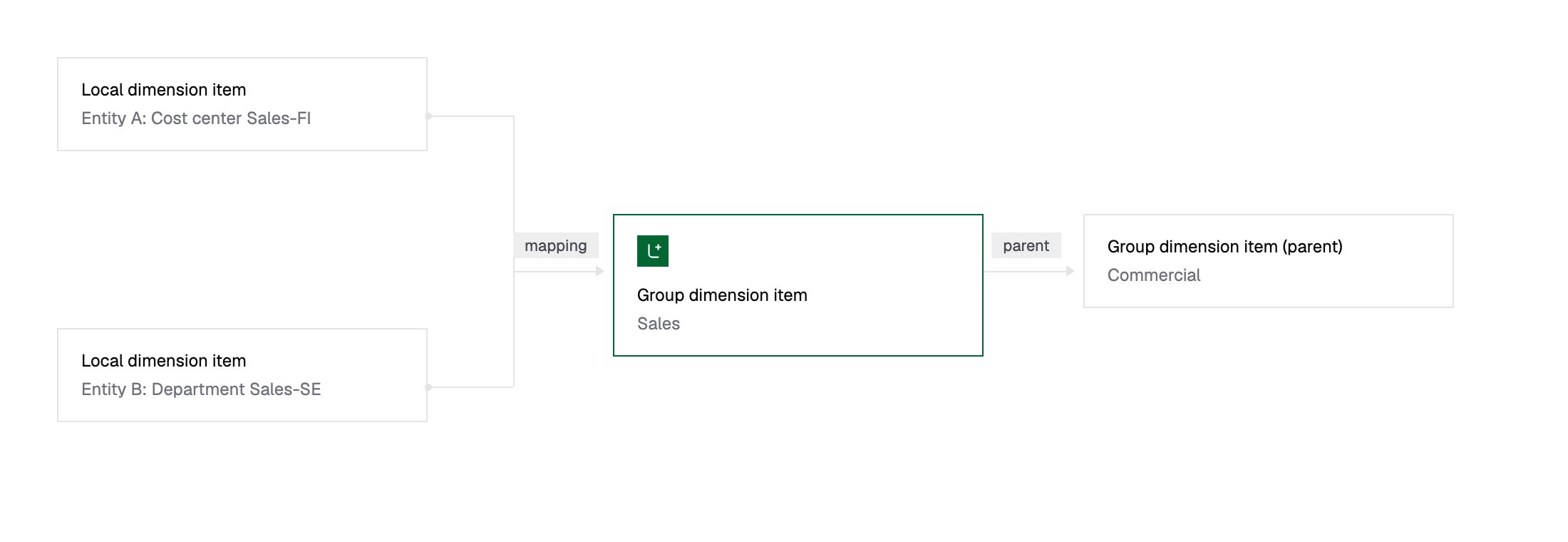
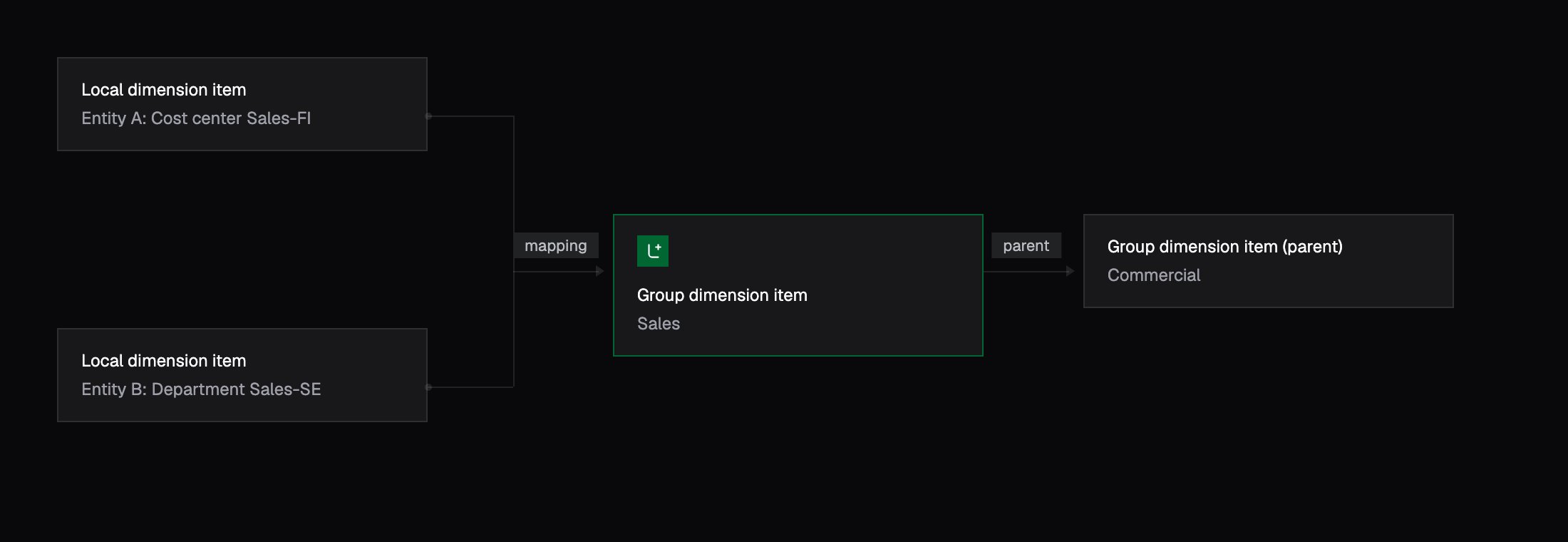 The **Group Dimensions** configuration shows each group item and its direct parent. Report selectors use those parent relationships to build the complete hierarchy.
Names in parentheses are normally part of the name received from the source system; parentheses are not special hierarchy syntax.
## What happens when source data changes
New source-system accounts and dimension items arrive as local records after a successful sync. They do not automatically become part of an established group structure unless an automation rule or accepted AI suggestion maps them.
Review new unmapped items regularly, especially after changing the chart of accounts or adding cost centers in a source system.
The **Group Dimensions** configuration shows each group item and its direct parent. Report selectors use those parent relationships to build the complete hierarchy.
Names in parentheses are normally part of the name received from the source system; parentheses are not special hierarchy syntax.
## What happens when source data changes
New source-system accounts and dimension items arrive as local records after a successful sync. They do not automatically become part of an established group structure unless an automation rule or accepted AI suggestion maps them.
Review new unmapped items regularly, especially after changing the chart of accounts or adding cost centers in a source system.